Day: December 20, 2021

  • How to improve Networking Skills ? Network Marketing

    What is networking?

    Networking isn’t merely the exchange of information with others — and it’s certainly not about begging for favors. Networking is about establishing, building, and nurturing long-term, mutually beneficial relationships with the people you meet, whether you’re waiting to order your morning coffee, participating in an intramural sports league, or attending a work conference. You don’t have to join several professional associations and attend every networking event that comes your way in order to be a successful networker. In fact, if you take your eyes off your smartphone when you’re out in public, you’ll see that networking opportunities are all around you every day.
    The importance of networking for career development

    Career development, in its simplest terms, is the lifelong evolution of your career. It’s influenced by a number of things that include the jobs you hold, the experiences you gain in and out of the office, the growth and success you achieve at each stage of your career, the formal and informal education and training you receive, and the feedback you’re provided with along the way.

    Ideally, organizations would place more emphasis on employee development in the workplace. However, the reality is that we live in what Carter Cast, author of the book, “The Right (and Wrong) Stuff: How Brilliant Careers Are Made,” refers to as “the era of do-it-yourself career development.”

    Cast explains that in today’s workforce, the burden is on you to take control of your career development. Hence the importance of networking for career development: As you network with people at your company, in your industry, and even outside your field of interest, you’ll uncover opportunities to connect with different types of mentors and advisors, increase your visibility with senior management, further develop your areas of expertise, and improve your soft skills.

    What Are the Benefits of Business Networking?

    Business networking might allow you to create awareness of or keep abreast of the latest trends or technology in your industry. A network can also provide you with professional mentors or contacts who might be able to assist you with problems you might need help with.

    For example, if your business needs the services of a bookkeeper, accountant, or lawyer you may find the ideal candidate through your network. If your business needs equity financing you may be able to find an angel investor or venture capitalist through networking channels.

    Networking is ideal for expanding your knowledge by taking advantage of the viewpoints and prior experience of others. For instance, if you are thinking of exporting your products or services, you may be able to get some valuable advice from someone else who has done similar business internationally.

    10 Most Valuable Networking Skills for Every Professional

    The best careers are built around the best networks. Great connections can provide you with learning opportunities, promotional opportunities, jobs, and more. The wrong connections, on the other hand, can drag your career down to their level of mediocrity. This makes it essential to develop strong networking skills so you can build the right network for your career.

    Essential networking skills for every professional:

    1. A focus on building genuine, long-term friendships

    2. Active listening

    3. The ability to frame things in a positive way

    4. The ability to focus on others’ needs before your own

    5. Confidence

    6. The ability to cope well with feedback and rejection

    7. Consistency

    8. Interviewing skills

    9. Email etiquette

    10. A solid elevator pitch

    Final thoughts

    Networking can be daunting, but it doesn’t have to be difficult. You can make it much easier by developing the following networking skills:

    • A focus on genuine, long-term relationships
    • Active listening
    • The ability to frame things in a positive way
    • The ability to focus on others’ needs before your own
    • Confidence
    • The ability to cope well with feedback and rejection
    • Consistency
    • Interviewing skills
    • Email etiquette
    • A solid elevator pitch

    With these networking skills in place, you are sure to build the kind of network that will in turn help you build a great career!


  • What is the Importance of Hashtag ? Everything about Hashtags

    Wondering how to use hashtags?

    Hashtags are everywhere! Love them or hate them, you can’t ignore them.

    What are hashtags?

    Once upon a time, a hashtag was just the hash mark or pound symbol, like so: #

    The revolution started in 2007 when Twitter began to use the hashtag as a method of indexing keywords for easy discovery.

    Other social sites jumped on the bandwagon, and now hashtags are ubiquitous on social media. The term has become so commonplace that it was added to the Oxford English Dictionary in 2010.

    You know that pound (#) sign on your keyboard? Just add it before a word and voila, you have a hashtag!

    A hashtag is a word or a group of words preceded by a pound (#) sign, which is used to categorize and find conversations around a particular topic or trend.

    A hashtag is a clickable link to a group of posts using the same hashtag.

    Yup, it’s that simple! You don’t have to be a teen or a computer geek to use hashtags.

    In geek-speak, hashtags are metadata tags which are used for grouping conversations. For example, suppose you are interested in Internet Marketing. You can search for #internetmarketing. Any social posts on Twitter, Instagram, Facebook and such that use this hashtag will surface, so you can be a part of the conversation.

    The very first hashtag was tweeted on August 23, 2007, by Chris Messina, a product designer and internet consultant.

    What are hashtags for?

    I have already explained what a hashtag is and even included a spoiler about what they are.

    Some people use these hashtags excessively without any clear objective, but the truth is that if you use these tags strategically and with sense, it can help you massively improve the results of your social networks.

    This social media resource is used to tag content so you can:

    • Search on a specific topic to collect all the information
    • Be easily found by your target audience
    • Give visibility to a specific topic

    Hashtag Basics

    While it sounds simple enough to place a hashtag in front of your keyword, there is some other basic information that is important to know when you are trying to be found by using hashtags. Using them only makes a difference in your marketing strategy when done the right way. Here are some general tips:

    • Don’t get carried away using a hashtag every couple of words. The number of hashtags that can be used depends on which platform you are using, but in most cases, one or two hashtags have more impact than a high number of them.
    • Keep hashtags short and memorable rather than trying to use a lot of words in one tag.
    • Don’t try to be too clever or unusual. If you choose a tag that no one is searching for, it won’t benefit your marketing.
    • Using hashtags that are detailed and specific will lead to better results than broad or general ones. Broad terms are not likely to be searched, and if you use them, your content will probably get lost in a sea of unrelated content.
    • Don’t try to force hashtags onto every post. Instead only use them when they add value to your post and are likely to stimulate conversation and interaction.
    • Hashtags can not only attract members of your target audience, they can also be used to research your competition. Search using hashtags, and you will uncover relevant content related to your topic.
    What is the Importance of Hashtag ? Everything about Hashtags

    Why use hashtags?

    Hashtags have become an essential part of our day-to-day vernacular, all thanks to social media. And there is probably no better way to distinguish a digital novice from a digital native than the way they use hashtags.

    Hashtags are often used as commentary or a punch line, but that’s not helpful to us as marketers.

    We want to use hashtags that help our content get discovered, and to be part of a larger conversation around topics relevant to our business.

    Hashtags are also useful to discover what’s trending, and to follow breaking news. Click on a hashtag to get a real-time feed of the posts using that hashtag, and get an overview of an event.

    Hashtag Do’s

    • The first step is to discover the hashtags used by others in your niche. Follow hashtags related to your line of business.
    • Before using a hashtag on a particular social channel, check out the rules. Although the fundamental principles are the same, the rules vary from one social channel to another. For example, Twitter focuses more on the topic while Instagram focuses on the description.
    • For a business, it’s important to perfect the art of targeting your audience. So get as specific as possible when using hashtags.
    • Get creative. The right hashtag has the power to go viral. After you’ve gotten the hang of using hashtags, try coming up with a new one. Who knows, it might become a trend!
    • Hashtags are not just for marketing and promotion but for engagement as well. Use hashtags to start a conversation and participate in that conversation. Engaging with your users is a key to a well-rounded business.
    • New as of Fall 2020: DO use hashtags on Facebook!


    Hashtag Don’ts

    • Don’t use a hashtag without research. Sounds simple, doesn’t it? Check whether the hashtag is already being used. If it is, note what it is being used for, to save yourself from possible embarrassment.
    • Don’t overdo it. Using too many hashtags will make your post look spammy and drown the message. Depending on the social channel, decide on the number of relevant hashtags that you can use. But in general, don’t have more hashtags than you have words.
    • Keep your hashtags short. Using overly long hashtags will confuse the visitors and put them off. #thisgivesmeaheadache – well, you got it!
    • Don’t use the same hashtags on all platforms. Silly or irreverent hashtags may fly on Twitter and IG, but not LinkedIn, where you should remain professional.
    • Avoid acronyms which are not popular or well known. Acronyms like #YOLO may work but ones like #MCM may not. For example, an acronym used by the Burger King (#WTFF) meaning What the French Fry – failed to gain any traction mainly because of the unfamiliarity of the hashtag.
  • Why Content Marketing is important ? Content Marketing Strategies

    Your business will be highly influenced by the marketing strategies you choose; it depends on your business’s success rate. Content marketing has proven to be the most powerful digital marketing strategy there is. Of course, social media marketing is famous, but it will not grow your sales as the content marketing strategy will. It offers you a bigger platform and a bigger audience.

    What is Content Marketing?

    Content marketing is the proven practice of generating interest in a business and its products/services by creating value for customers through engaging and informative content. As a marketing practice that spans traditional and digital channels, content marketing is an integral component of any successful marketing organization.

    Why is Content Marketing Important?

    Content is the foundation of just about every type of online customer interaction. From search and discovery through consideration and on to conversion, content helps consumers make decisions. Content marketing helps brands maximize their return on investment in content by ensuring that each content asset—whether a blog post, email, article, infographic, video, or any other format—reaches the most receptive and relevant audience.

    Types of Content Marketing 

    • Blogging
    • Video Content
    • Podcasts 
    • Infographics
    • Case Studies
    • Testimonials & Customer Reviews
    • White Papers
    • Influencer Marketing
    • Email / Newsletters
    • Social Media
    Why Content Marketing in important

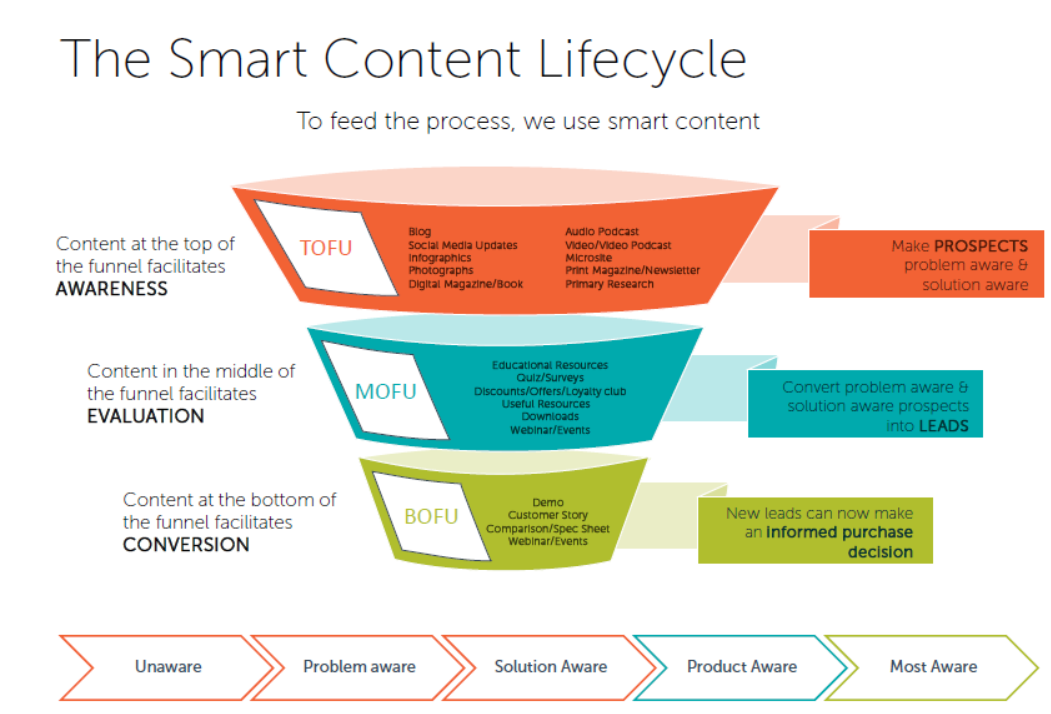
    Content is important during each step of the marketing funnel.

    Now let’s think about the importance of content marketing when it comes to your marketing funnel.

    There are three major areas of your marketing funnel that you need to think about while you’re developing your digital marketing campaigns.

    And content marketing plays a role during each stage of the funnel.

    Here’s where content marketing comes in throughout the marketing funnel:

    • Top-of-Funnel (TOFU):

    At the top of the funnel, your prospective customers are just starting to become aware of their problems.

    They are also starting to become aware that there are solutions available.

    During this stage, content can help educate them and get them the information they need to decide which type of solution might help

    .

    • Middle-of-Funnel (MOFU):

    At the middle of the funnel, leads are evaluating their options for products or solutions.

    Content during this stage of the funnel is meant to educate leads on what their different options are.

    This will allow them to start narrowing their choices and come closer to a final purchasing decision.

    • Bottom-of-Funnel (BOFU):

    Once leads reach the bottom of the funnel, this means that they are ready to convert.

    Content during this stage is meant to give a final nudge of encouragement to the buyer and empower them to make an informed purchasing decision.

    To get a better understanding of content in each stage of the funnel, take a look at this graphic:

    Content Marketing Strategies

    Here you can see how content marketing plays a role through every stage of the marketing funnel as well as which types of content work best to top, middle, and bottom-of-funnel leads.

    When creating content marketing to reach potential customers at each stage, be aware of what each lead needs at this point in their buyer’s journey.

    Prospects at the top of the funnel need more general information that helps them better understand their challenges and potential solutions.

    Leads who reach the middle of the funnel need more detailed information that encourages them to evaluate their options.

    While leads at the bottom of the funnel need content with specific details about your unique offer to help them make an educated purchasing decision.