Day: December 17, 2022

  • Trending Technologies in 2023

    The annual ritual of predicting the next solar orbit and identifying technological trends kicks into high gear as the new year approaches. These kinds of activities are always interesting, but they are also always risky, especially in uncertain times like the ones we’ve just gone through and continue to go through. 

    For instance, few people at the end of 2019 could have predicted that a global pandemic would turn the workplace upside down the following year, resulting in an unprecedented focus on remote working-friendly devices and services and a likely permanent shift to a hybrid model.

    Then, Russia’s invasion of Ukraine in February 2022 brought about a sharp rise in energy costs, increased inflation, issues with supply chains, and fears of a widespread recession just as economies were adjusting to and recovering from the pandemic. The IT industry will likely continue to be affected by this series of shocks through at least 2023.

    Therefore, perhaps the most significant advantage of the annual round of tech soothsaying is not so much the opportunity to evaluate the general direction of travel as the fine-grained detail, which is frequently derailed by contact with unexpected even

    Trending Technologies in 2023 Best Online Cloud Computing Training

    Futuristic Trending Technologies in 2023

    AI: The future

    Artificial intelligence will become operational in businesses in 2023. Any company will be able to use No-Code AI’s intuitive drag-and-drop interfaces to develop more intelligent products and services.

    In the retail market, we already see this trend. Stitch Fix uses AI-enabled algorithms to suggest clothes that fit customers’ sizes and preferences.

    Contactless, independent shopping and conveyance will likewise be a tremendous pattern for 2023. Customers will be able to pay for and receive goods and services more easily with AI.

    Additionally, AI will enhance nearly every job and business procedure across industries. Buy-online-pickup-at-curbside (BOPAC), buy-online-pickup-in-store (BOPIS), and buy-online-return-in-store (BORIS) convenience trends will become commonplace as more retailers use AI to manage and automate the intricate inventory management processes that take place behind the scenes.

    Retail workers will increasingly need to become accustomed to working alongside machines in order to perform their duties, and AI will also be the driving force behind the most recent initiatives for autonomous delivery that retailers are piloting and implementing.

    Metaverse Will Become Real

    The term “metaverse” has become a catch-all for a more immersive internet where we will be able to work, play, and socialize on a persistent platform. Although I don’t particularly like the term, parts of the metaverse will become real.

    By 2030, experts anticipate that the metaverse will contribute $5 trillion to the global economy, and 2023 will be the year that determines the metaverse’s future course.

    Technology for virtual reality (VR) and augmented reality (AR) will continue to advance. The metaverse’s work environment is something to keep an eye on. In 2023, I predict that we will have more immersive meeting spaces where we can talk, brainstorm, and collaborate on projects.

    In point of fact, Microsoft and Nvidia are already working on metaverse platforms for digital project collaboration.

    A more advanced avatar technology is also coming in the new year. A symbol — the presence we project as we draw in with different clients in the metaverse — could closely resemble what we do in reality, and movement catch will try and empower our symbols to embrace our special non-verbal communication and signals.

    We additionally could see further improvement in artificial intelligence empowered independent symbols that can go about as our agents in the metaverse, regardless of whether we’re not signed into the advanced world.

    Training and onboarding are already being carried out by businesses with the help of metaverse technologies like augmented reality (AR) and virtual reality (VR). Accenture, a global consulting firm, has already developed the Nth Floor, a metaverse environment. With replicas of actual Accenture offices in this virtual world, both new hires and current employees can complete HR-related tasks without having to be physically present in an office.

    Bridging the Gap Between Digital & Physical World

    Bridging the Digital and Physical Worlds Already, a bridge between the digital and physical worlds is forming, and this trend will continue into 2023. This merger consists of two parts: technology for digital twins and 3D printing.

    Digital twins are safe digital simulations of actual processes, procedures, or products that can be used to test new ideas. Digital twins are being used by designers and engineers to recreate real-world objects within virtual worlds so that they can test under every possible circumstance without incurring the high costs of real-world experiments. We will see even more digital twins in 2023, in everything from automobiles to precision healthcare to factories.

    Engineers can tweak and edit components during virtual testing before using 3D printing technology to make them in the real world.

    For instance, in order to observe how cars change during races, Formula 1 teams currently collect data transmitted from sensors, race track temperatures, and weather conditions. After that, they run scenarios and stream the data from the sensors to digital twins of the engines and car parts to make on-the-fly design adjustments. Based on their testing, the teams then 3D print car parts.

    Progress in Quantum Computing 

    There is currently a global competition to scale up quantum computing.

    The technological leap known as quantum computing, which makes use of subatomic particles to develop novel methods for processing and storing information, is anticipated to result in computers that can function a trillion times faster than the fastest traditional processors currently available.

    Any nation that develops quantum computing on a large scale could break the encryption of other nations, businesses, security systems, and other systems. This is the potential danger of quantum computing because it could render our current encryption practices useless. As countries like the United States, the United Kingdom, China, and Russia invest in the development of quantum computing technology in 2023, this is a trend to closely monitor.

    Robots Will Look and Perform More Like Humans – Trending Technologies in 2023

    By 2023, robots will look and perform more like human beings. In the real world, these robots will be used as bartenders, concierges, event greeters, and companions for the elderly. As they collaborate with humans in manufacturing and logistics, they will also carry out intricate tasks in warehouses and factories.

    One company is putting in a lot of effort to make a robot that looks like a human and can work in our homes. Elon Musk said that Tesla would be ready to take orders within three to five years at Tesla AI Day in September 2022. He also showed two Optimus humanoid robot prototypes. The robot is able to do simple things like lift things and water plants, so we might soon be able to have “robot butlers” to help with housework.

    Autonomous System Development 

    Business leaders will keep developing autonomous system development, particularly in delivery and logistics. Already, many warehouses and factories are either partially or completely autonomous.

    In 2023, we will see an even greater number of delivery robots, self-driving ships and trucks, and autonomous technology will be implemented in even more factories and warehouses.

    In its highly automated warehouses, Ocado, a British online supermarket that bills itself as “the world’s largest dedicated online grocery retailer,” employs thousands of autonomous robots to sort, lift, and move groceries. The most popular items are also placed within easy reach of the robots by the warehouse using AI. The autonomous technology that powers Ocado’s successful warehouses is now being rolled out to other grocery retailers.

    Important Links

    Home Page 

    Courses Link  

    1. Python Course  
    2. Machine Learning Course 
    3. Data Science Course 
    4. Digital Marketing Course  
    5. Python Training in Noida 
    6. ML Training in Noida 
    7. DS Training in Noida 
    8. Digital Marketing Training in Noida 
    9. Winter Training 
    10. DS Training in Bangalore 
    11. DS Training in Hyderabad  
    12. DS Training in Pune 
    13. DS Training in Chandigarh/Mohali 
    14. Python Training in Chandigarh/Mohali 
    15. DS Certification Course 
    16. DS Training in Lucknow 
    17. Machine Learning Certification Course 
    18. Data Science Training Institute in Noida
    19. Business Analyst Certification Course 
    20. DS Training in USA 
    21. Python Certification Course 
    22. Digital Marketing Training in Bangalore
    23. Internship Training in Noida
    24. ONLEI Technologies India 
  • Top Data Science Certifications in 2023 , Data Science Jobs

    Today We are having a great topic that is Top Data Science Certifications in 2023 , Data Science Jobs. So Let’s start the topic.

    The supply of data scientists is still outpacing the demand. According to a Quanthub study, there will be a shortage of 250,000 data scientists in 2020, and there will be three times as many job postings for data scientists as job searches. Additionally, the requirement for data scientists is only increasing. The demand for data scientists is expected to rise by 36% over the next ten years, according to the Bureau of Labor Statistics in the United States.

    If you want to work in data science, you can be sure that your skills will always be in demand. Additionally, salaries in data science are rising; even entry-level positions typically pay in the six figures.

    If any of that piques your interest, you might be wondering, “How do I become a data scientist?” You are not the only one who has this question. There isn’t a set path to becoming a data scientist, at least not in the same way that there is for other high-paying professionals like doctors and lawyers, because data science is such a new and developing field.

    A number of online data science courses have emerged in an effort to educate the data scientists of the future. However, choosing the right course can be challenging because there are so many options and so many different kinds of courses.

    Top Data Science Certifications in 2023 , Data Science Jobs

    Is getting a data science certification worth it? Top Data Science Certifications in 2023

    The response to the question, “Is certification in data science worth it?” Totally yes! Did you know that data scientists hold some of the most highly paid and in-demand IT positions in the world? One of the main reasons that data scientists are so valuable is that they can sort through a lot of data, look for patterns, and keep an eye on changes that affect important business decisions. This helps the companies they work for stay competitive. Data science is being used proactively by businesses to increase efficiency, but one of the biggest obstacles is a lack of skills within the company to help them achieve their data goals. Regardless of the innovation brand you use, AWS, IBM, VMware, or others, there has never been a superior chance to procure information science certificates online than now.

    Accessing and organizing data from multiple platforms to build a narrative is in demand more than ever in the age of endless reporting capabilities provided by cutting-edge software-as-a-service programs. This is because it can be difficult for businesses to report on hundreds to thousands of data points on a regular basis. The emerging field of data science can be a rewarding career choice to meet the growing demand for professionals with training in data analysis.

    In today’s digital economy, it is essential for young professionals and businesses to obtain relevant skills and earn a certificate in data science.

    How to Choose a Data Science Certificate Program – Top Data Science Certifications in 2023 , Data Science Jobs

    Data Science Certificate Program in 5 Steps 

    It is simple to locate a certificate-granting data science program. A fast Google search will turn up handfuls.

    Unfortunately, you must make a difficult choice. You want to contrast this multitude of projects with concluding whether the authentication merits your time and cash.

    Let’s make this process easier. When considering a data science certification, here are five important considerations to keep in mind:

    • Content of the program
    • Cost of the program
    • Prerequisites or qualifications required 
    • Time commitment required 
    • Reviews from previous students 

    ONLEI Technologies Certification: will it help you get a data science job?

    Yes, obtaining a ONLEI Technologies certificate in data science is worthwhile because it demonstrates that you have acquired the necessary skills in data analysis and machine learning to advance your career in data science and land your dream job.

    There are numerous data science courses offered by ONLEI Technologies that combine theory and practice. They give you the fundamental skills you need to become a certified data professional. To increase your chances of getting hired, you can even include this ONLEI Technologies certificate in your LinkedIn profile.

    In an interactive learning environment, a variety of experts teach these online courses. You will have the opportunity to learn more about programming by working on real-world projects.

    Take a ONLEI Technologies Data Science Certification Course 

    The ONLEI Technologies data science certification course was developed in collaboration with industry professionals. The career coaches on this online learning platform will help you with your job application after you get certified to get a data science job and get noticed by employers.

    There are two ONLEI Technologies online certifications in data science, each with a set of courses:

    Certificate as a Data Scientist Data management, exploratory analysis, model development, statistical experimentation, coding for production, and communication are among the data science skills tested.

    Certificate as a Data Analyst Data management, exploratory analysis, analytical fundamentals, visualizations and reporting, and communication are the skill tracks being tested.

    You can begin your career in any direction you choose. Timed assessments, coding challenges, and an online live presentation in front of experts and non-experts are all part of these certification programs.

    ONLEI Technologies Data Science Certificate guarantees that the content is current and relevant. As a result, deciding between the two certifications depends on your willingness to put in both time and money.

    Important Links

    Home Page 

    Courses Link  

    1. Python Course  
    2. Machine Learning Course 
    3. Data Science Course 
    4. Digital Marketing Course  
    5. Python Training in Noida 
    6. ML Training in Noida 
    7. DS Training in Noida 
    8. Digital Marketing Training in Noida 
    9. Winter Training 
    10. DS Training in Bangalore 
    11. DS Training in Hyderabad  
    12. DS Training in Pune 
    13. DS Training in Chandigarh/Mohali 
    14. Python Training in Chandigarh/Mohali 
    15. DS Certification Course 
    16. DS Training in Lucknow 
    17. Machine Learning Certification Course 
    18. Data Science Training Institute in Noida
    19. Business Analyst Certification Course 
    20. DS Training in USA 
    21. Python Certification Course 
    22. Digital Marketing Training in Bangalore
    23. Internship Training in Noida
    24. ONLEI Technologies India 
  • What is Python? Why it is so popular nowadays?

    What is Python? Why it is so popular nowadays?

    Python is a computer programming language often used to build websites and software, automate tasks, and conduct data analysis. Python is a general-purpose language, meaning it can be used to create a variety of different programs and isn’t specialized for any specific problems.

    Python is a widely-used general-purpose, high-level programming language. It was initially designed by Guido van Rossum in 1991 and developed by Python Software Foundation. It was mainly developed for emphasis on code readability, and its syntax allows programmers to express concepts in fewer lines of code . 

    What is Python and its benefits?

    Python programming language is a general-purpose, interpreted, and high-level language that mainly offers code readability. It is largely used by professional programmers and developers across a variety of fields, including Web Development and Machine Learning.

    Python is a high-level, general-purpose, interpreted object-oriented programming language. Similar to PERL, Python is a programming language popular among experienced C++ and Java programmers.

    Top Reasons to Learn Python

    • Data science.
    • Scientific and mathematical computing.
    • Web development.
    • Finance and trading.
    • System automation and administration.
    • Computer graphics.
    • Basic game development.
    • Security and penetration testing.

    Defining a Function

    You can define functions to provide the required functionality. Here are simple rules to define a function in Python.

    • Function blocks begin with the keyword def followed by the function name and parentheses ( ( ) ).
    • Any input parameters or arguments should be placed within these parentheses. You can also define parameters inside these parentheses.
    • The first statement of a function can be an optional statement – the documentation string of the function or docstring.
    • The code block within every function starts with a colon (:) and is indented.
    • The statement return [expression] exits a function, optionally passing back an expression to the caller. A return statement with no arguments is the same as return None.

    Syntax : 

         def functionname( parameters ):

       “function_docstring”

       function_suite

       return [expression]

    The python language is one of the most accessible programming languages available because it has simplified syntax and not complicated, which gives more emphasis on natural language. Due to its ease of learning and usage, python codes can be easily written and executed much faster than other programming languages.

    The first and topmost reason why python is the most popular programming language is due to the fact that it is easy to use and learn. Due to this ease, it is considered as the most fresher-friendly programming language. Python is one of the most approachable programming languages available.

    9 Factors of Python Popularity

    1. Python is easy to learn

    2. Python has an active, supportive community

    3. Python is flexible

    4. Python offers versatile web-development solutions

    5. Python is well suited to data science and analytics

    6. Python is efficient, fast, and reliable

    7. Python is widely used with IoT Technology

    8. Python empowers custom automation

    9. Python is the academic language

    Due to its ease of learning and usage, Python codes can easily be written and executed much faster than other programming languages. One of the main reasons why Python’s popularity has exponentially grown is due to its simplicity in syntax so that it could be easy to read and developed by amateur professionals as well.

    Important Links

    Home Page 

    Courses Link  

    1. Python Course  
    2. Machine Learning Course 
    3. Data Science Course 
    4. Digital Marketing Course  
    5. Python Training in Noida 
    6. ML Training in Noida 
    7. DS Training in Noida 
    8. Digital Marketing Training in Noida 
    9. Winter Training 
    10. DS Training in Bangalore 
    11. DS Training in Hyderabad  
    12. DS Training in Pune 
    13. DS Training in Chandigarh/Mohali 
    14. Python Training in Chandigarh/Mohali 
    15. DS Certification Course 
    16. DS Training in Lucknow 
    17. Machine Learning Certification Course 
    18. Data Science Training Institute in Noida
    19. Business Analyst Certification Course 
    20. DS Training in USA 
    21. Python Certification Course 
    22. Digital Marketing Training in Bangalore
    23. Internship Training in Noida
    24. ONLEI Technologies India 
  • How Will Robotic Process Automation (RPA) Affect Outsourcing?

    Humans used to do all the hard work with limited resources before computers were invented. With the development of computers, it became possible to perform massive calculations and data storage with a single mouse click. Still, the system could not be used without a human operator. Now, the ever-evolving technology will make it possible to eliminate humans as well.

    Imagine giving instructions to your computer to complete this, that, and the report for you. Is it feasible and efficient?

    The response is “yes.”

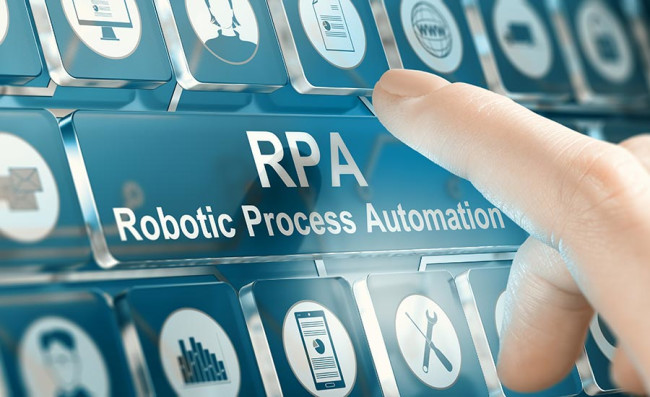
    RPA, or robotic process automation, comes into play right here. Automating basic and repetitive office tasks is done with RPA systems.

    This kind of technology has the potential to have a significant impact on the development of BPO in the future.

    BPO, or business process outsourcing, is a practice that has been around for some time and is getting more and more popular. BPO is used by lean start-ups and multinational corporations, but there is still a lot of confusion about what it is, its benefits, its risks, and how it works with robotic process automation (RPA).

    What is Business Process Outsourcing ?

    The practice of using a third-party provider to carry out business processes is known as BPO. Accounting, payroll, customer service, and marketing are all common areas of business that are outsourced to BPO vendors.

    The types of tasks that can be outsourced using Business Process Outsourcing can be divided into two categories, despite the fact that the examples vary and are typically owned by different business divisions:

    • Back office functions :  Processes that primarily include internal operations like billing, purchasing, payment processing, and IT services are referred to as back office functions.
    • Front office functions : Operations that involve acquiring and assisting an organization’s clients are referred to as front office functions. Marketing and sales activities, technical support, and customer success are basic front office processes.

    Business process outsourcing can also be broken down into the following subcategories based on the location of the contracted third-party vendor:

    • Offshore: Offshore refers to BPO vendors based outside the nation of the organization. An example of an offshore vendor would be an American business that outsources business processes to an Indian provider.
    • Nearshore: BPO vendors that are situated in nations that are close by are referred to as “nearshore.”
    • Onshore: BPO providers that are based in the same country as the companies that outsource their business processes are called “onshore.” An example of an onshore provider would be a company in Chicago, Illinois, that outsources its processes to a vendor in Austin, Texas.

    What is Robotic Process Automation (RPA) ?

    The use of software robots, or “bots,” to complete repetitive, rules-based tasks within or between computer systems is known as robotic process automation, or RPA. There is no need to create original software integrations because the bots carry out this work through preexisting user interfaces.

    With RPA, bots are trained to operate software almost like humans would (using the same user interface and producing the same results, but not necessarily at the keystroke level). This method can also be used to complete tasks that require multiple programs to be completed. Bots can scale to meet changing demand once they have been trained to do a task.

    Without the need for breaks or quality checks, bots quickly complete tasks in the same way each time. RPA is a great fit for back-office processes that rely heavily on data. Bots can assume control over information passage or relocation between bookkeeping sheets, for example, or between messages, contact structures, or detailing stages — however these are only a couple of instances of the many purposes for RPA.

    How will outsourcing be affected by robotic process automation?

    Do you think that the old methods of Business Process Outsourcing (BPO) have died out?

    This might be the case.

    In order to meet rising customer expectations, the most recent Harvey Nash reports indicate that nearly 33% of Asia-Pacific CIOs are implementing cutting-edge technologies.

    In the business world, automation is the new craze, and it’s here to take over some routine daily tasks.

    7/10 tech giants are leveraging their technological capabilities to enhance the user and employee experience in order to keep up with the ever-changing trends in the global market.

    In all major industries, robotics are now an essential part of the automation process. The term “Robotic Process Automation” (RPA) is a recent buzzword in the market.

    Take a course in robotic process automation if you want to stop dealing with unnecessary human intervention and instead concentrate on improving the quality of your work!

    RPA’s threat to BPO

    The threat that RPA poses to BPO RPA has the potential to render many outsourcing partnerships obsolete. Experts from Deloitte Consulting, Everest Group, and KPMG estimate that RPA outperforms outsourcing by more than 70%. However, RPA’s threat to outsourcing extends beyond cost savings. Companies stand to gain the following advantages if they adopt RPA as their outsourcing strategy:

    Unlimited authority: Your automation is driven and delivered by your organization, making it impossible for an outsider to lose sight of your business’s objectives and vision.

    Reduce costs: RPA implementation and design typically come in at a fraction of the cost of a typical outsourcing contract.

    Numerous applications: RPA can be used for a wide range of business procedures. RPA is a good fit for tasks that can be defined and based on rules.

    Scale according to demand: RPA can be quickly and easily scaled up or down to meet the changing needs of your business.

    Transparency in communication: Your RPA robot only needs one training session. After that, the bot can reliably, accurately, and without complaining repeat the task sequence.

    Accuracy: RPA robots are incredibly exact.

    Compliance: RPA can be programmed to always adhere to a predetermined set of operating procedures and to keep an audit trail of its actions to ensure compliance with business requirements.

    In a nutshell, since RPA can be carried out entirely in-house, businesses can avoid many of the drawbacks of outsourcing and take advantage of the majority of its advantages.

    What effect does RPA have on business process outsourcing?

    When businesses re-absorb their business processes and automate them in-house, it is commonly believed that robotic process automation (RPA) will replace business process outsourcing.

    The more sensible situation that is now happening as expected is that RPA is another help BPO merchants offer under their umbrella. It is thought that outsourcing the automation of business processes to a BPO vendor is another way to combine the advantages of RPA and BPO to get even more value by adding value propositions like:

    • Lower operating expenses
    • Increased productivity 
    • Better output quality 
    • Fewer errors all contribute to better customer and employee experiences.

    The shortcomings of RPA in comparison to outsourcing 

    Don’t blink; this section is brief due to the few shortcomings of RPA in direct comparison to outsourcing.

    Scannable images and unstructured data, such as free-form emails and attachments, cannot be processed by RPA as effectively as by a human. To be useful to the bots, businesses must first accurately digitize this kind of data using OCR or technology similar to it.

    An error in one entry or transaction can be repeated across multiple entries in multiple applications because of RPA’s very nature.

    RPA’s productivity and competitive advantage over a human counterpart are diminished if a company frequently changes its standard processes because RPA is best suited to rules-driven processes.

    Because human interaction can never be replaced by RPA robots, some outsourcing tasks are simply not suitable for this technology.

    Bringing it home for the midmarket business 

    If you’re a mid market business, you might think that talking about offshore or nearshore outsourcing doesn’t really matter to you. And you might be correct. Yet, proficiency, efficiency, and cost reserve funds are pertinent to you – and that is what’s really going on with Rpa. RPA excels in this segment of the midmarket. Mid Market businesses greatly benefit from RPA. Utilizing your assets is even more important when you have fewer resources than larger businesses. Your mid market business can grow and scale with agility and precision with the help of robotic process automation, allowing you to invest in strategic tasks that reward your human capital as well as your bottom line.

    Important Links

    Home Page 

    Courses Link  

    1. Python Course  
    2. Machine Learning Course 
    3. Data Science Course 
    4. Digital Marketing Course  
    5. Python Training in Noida 
    6. ML Training in Noida 
    7. DS Training in Noida 
    8. Digital Marketing Training in Noida 
    9. Winter Training 
    10. DS Training in Bangalore 
    11. DS Training in Hyderabad  
    12. DS Training in Pune 
    13. DS Training in Chandigarh/Mohali 
    14. Python Training in Chandigarh/Mohali 
    15. DS Certification Course 
    16. DS Training in Lucknow 
    17. Machine Learning Certification Course 
    18. Data Science Training Institute in Noida
    19. Business Analyst Certification Course 
    20. DS Training in USA 
    21. Python Certification Course 
    22. Digital Marketing Training in Bangalore
    23. Internship Training in Noida
    24. ONLEI Technologies India 
  • Why Machine Learning is better than Statistics ?

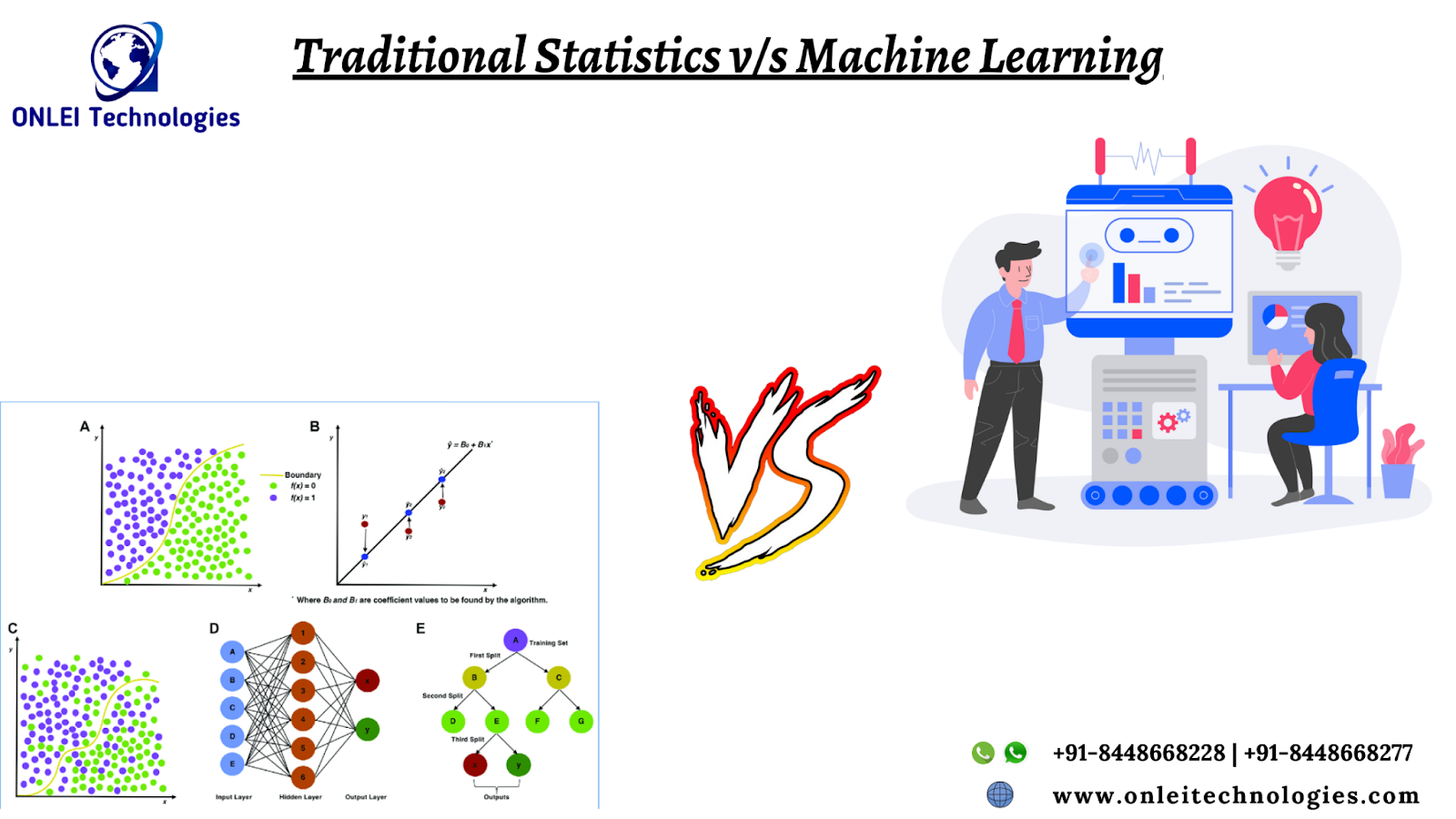
    “Machine Learning (ML)” and “Traditional Statistics(TS)” have unique philosophies in their approaches. With “Data Science” in the forefront getting masses of attention and interest, I want to dedicate this blog to discuss the differentiation among the 2. I frequently see discussions and arguments among statisticians and data miners/machine learning practitioners at the definition of “data science” and its coverage and the specified skill sets. All that is needed is simply being attentive to the evolution of these fields.

    There is no doubt that once we communicated about “Analytics,” each data mining/machine learning and conventional statistician had been a player. However, there may be a massive distinction in approach, applications, and philosophies of the 2 camps that is frequently overlooked.

    Machine Learning

    Machine learning is the future technology. It is developing at a rapid pace. During the previous couple of years, machine learning has reached the next level. It is utilized in numerous fields like fraud detection, web search results, real-time ads on web pages and mobile devices, image recognition, robotics, and lots of different areas.

    Machine learning is part of computer science. It has been advanced from the study of computational learning and theory in artificial intelligence. Machine Learning works with AI. In different words, machine learning offers the ability to the computers to research new matters with the help of some programs.

    Machine learning is likewise beneficial to make predictions on data. It constructs a few algorithms that are operated via means of a model creation, and it is used to create data-driven predictions. Machine learning has performed a crucial position in the functionality of human society.

    Statistics

    Statistics is all about the study of collection, analysis, interpretation, presentation, and organization of data. Whenever we use statistics in scientific, and industrial problems, we start the system by deciding on a statistical model system.

    Statistics perform a vital role in human activity. It means that with the help of statistics, we can track human activities. It facilitates us in identifying the per capita income of the country, the employment rate, and much more. In different words, statistics assist us to conclude from the facts we have collected.

    When would you use machine learning over statistics?

    Clough’s egg analogy is beneficial in exploring this further. “The machine learning model doesn’t tell you anything about running a more efficient farm,” he suggests, “while the statistical model would be unwieldy if you owned tens of thousands of chickens.”

    When looking at massive data sets, machine learning can be extra optimal. Many concede statistics are not able to provide a deeper analysis at the relationships and correlations among the data whilst the stages of data are high. They additionally can’t be relied on for causation, probability, and certainty because the chance is that they are probably misinterpreted or intentionally misused to back up a selected argument. As the well-known announcement goes: “There are lies, damn lies, and there are statistics.” Human involvement provides a weakness in statistics.

    Basios, however, explains you could observe statistical modeling while you understand “specific interaction effects between variables” and “have prior knowledge about their relationships”. Machine learning, meanwhile, may be used when aiming for “high predictive accuracy”.

    It has a tendency to be ‘deployed’ extra on the source of the data; as that is accrued and grows, algorithms robotically start to provide intelligence. In manufacturing, for instance, it may predict whilst machines will need maintenance, reducing disruption. It also can examine one option when compared to another – predicting which outcome would be better.

    Industries Using Machine Learning

    The evolution of computers and technologies has produced machine learning. Machine learning has modified the manner we live our lives. There are masses of industries that are using machine learning.

    • Google is using machine learning in their self-driven cars. Netflix is one of the most tremendous examples of machine learning technologies. Netflix is using machine learning to customize the content for its customers.
    • It analyzes human behavior and then presents the best-matched content to the customer. Machine learning is likewise beneficial in fraud detection, and it facilitates the brands to be secure in nearly each platform. 
    • Machine learning is getting more popular due to the fact the data is also developing at a rapid pace. It permits us to analyze a big amount of data in much less time and low cost with the assistance of powerful data analysis methods. It facilitates us to quickly produce models that can examine the massive amount of data and deliver faster solutions, even on a huge scale.

    Industries Using Statistics

    Almost every industry uses statistics. Because without statistics, we can’t get the conclusion from the data. Nowadays, statistics is important for diverse fields like eCommerce, trade, psychology, chemistry, and much more. 

    Business

    Statistics is one of the tremendous aspects of companies. It is playing an important position in the industry. Nowadays, the arena is becoming more competitive than ever before.

    It is turning into more difficult for the business to live in the competition. They want to fulfill the customer’s goals and expectations. It can only happen if the organization takes quick and better decisions.

    So how can they do so? Statistics play an important position in understanding the goals and expectancies of the customers. It is, therefore, crucial that brands take quick decisions so that they can make better decisions. Statistics provide beneficial insights to make smarter decisions.

    Economics

    Statistics is the base of Economics. It is playing a crucial function in economics. National income report is a vital indicator for economists. There are diverse statistics strategies carried out on the data to investigate it.

    Statistics is likewise useful in defining the connection among demand and supply. It is likewise required in nearly each aspect of economics.

    Banking

    Statistics play a vital element in the banking sector. Banks require statistics for a wide variety of different reasons. The banks work on pure phenomena. Someone deposits their cash in the bank.

    Then the banker estimates that the depositor will now no longer withdraw their cash in the course of a period. They additionally use statistics to make investments the cash of the depositor into the funds. It facilitates the banks to make their profit.  

    State Management

    Statistics is a vital factor of the development of the country. Statistical data is broadly used to make administrative level decisions. Statistics are important for the government to perform its duties efficiently.

    Difference between Machine Learning & Statistics

    Machine Learning (ML)Traditional Statistics (TS)
    Goal: “learning” from data of all sortsGoal: Analyzing and summarizing statistics
    No rigid  pre-assumptions about the hassle and data distributions in generalTight assumptions about the hassle  and data distributions
    More liberal in the strategies and approachesConservative in strategies and approaches
    Generalization is pursued empirically through training, validation and check datasetsGeneralization is pursued the usage of statistical tests on the training dataset
    Not shy of using heuristics in methods looking for a “desirable solution”Using tight preliminary assumptions about data and the problem, generally looking for an optimal solution under those assumptions
    Redundancy in features (variables) is okay, and often helpful. Preferable to use algorithms designed to handle large range of featuresOften calls for independent features. Preferable to use less range of input features
    Does now no longer promote data reduction prior to learning. Promotes a tradition of abundance: “the more data, the better”Promotes data reduction as much as feasible before modeling (sampling, less inputs, …)
    Has been confronted with fixing greater complicated problems in learning, reasoning, perception, knowledge presentation, …Mainly targeted on conventional data analysis

    Important Links

    Home Page 

    Courses Link  

    1. Python Course  
    2. Machine Learning Course 
    3. Data Science Course 
    4. Digital Marketing Course  
    5. Python Training in Noida 
    6. ML Training in Noida 
    7. DS Training in Noida 
    8. Digital Marketing Training in Noida 
    9. Winter Training 
    10. DS Training in Bangalore 
    11. DS Training in Hyderabad  
    12. DS Training in Pune 
    13. DS Training in Chandigarh/Mohali 
    14. Python Training in Chandigarh/Mohali 
    15. DS Certification Course 
    16. DS Training in Lucknow 
    17. Machine Learning Certification Course 
    18. Data Science Training Institute in Noida
    19. Business Analyst Certification Course 
    20. DS Training in USA 
    21. Python Certification Course 
    22. Digital Marketing Training in Bangalore
    23. Internship Training in Noida
    24. ONLEI Technologies India